
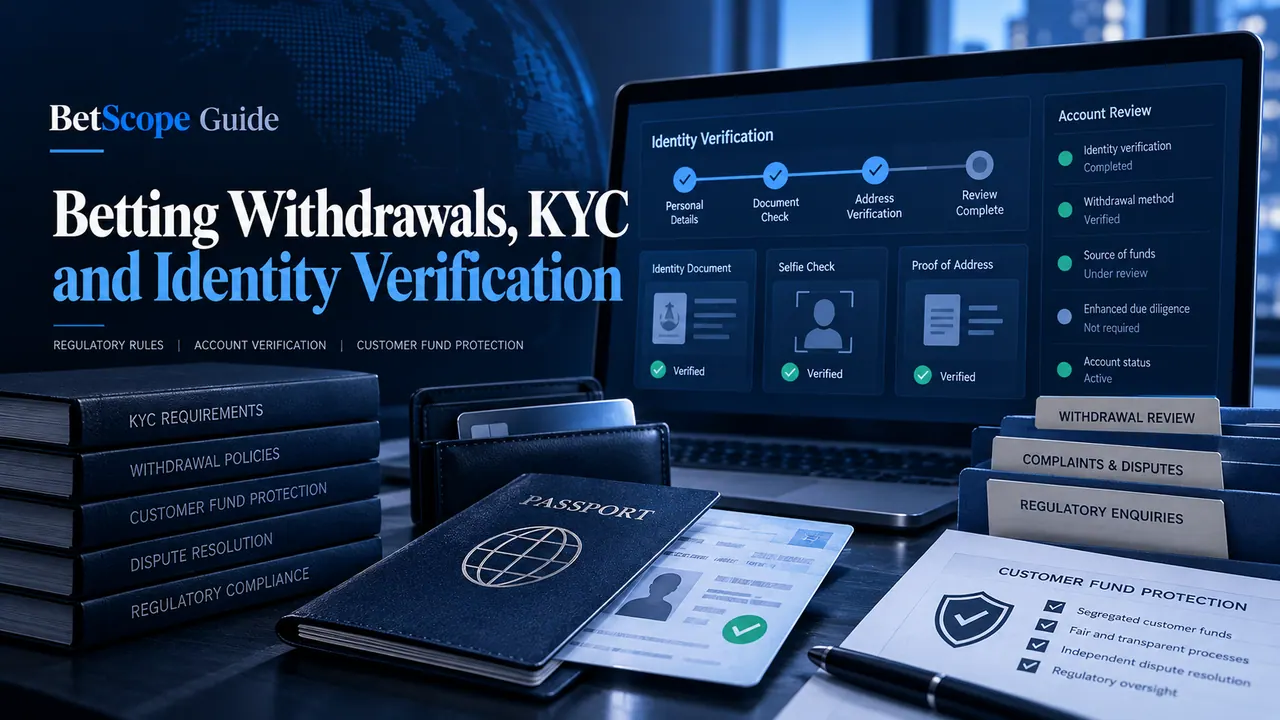
Research reviewed: 12 October 2026. Focus: regulatory methods and documented Great Britain rules; other jurisdictions may apply different requirements. This is an educational guide, not a guarantee of payment or legal advice.
KEY FINDINGS
Identity checks, anti-money-laundering (AML) reviews, fraud investigations and payment-provider processing are distinct reasons for account checks. A pending withdrawal is not proof of wrongdoing by either the customer or operator. In Great Britain, the UK Gambling Commission (UKGC) says operators should verify age and identity before gambling, and should not delay an otherwise available withdrawal with information that could reasonably have been requested earlier. Legitimate later legal checks can still occur.
1. THE STAGES OF A WITHDRAWAL
A withdrawal may involve a customer request, operator review, confirmation of eligible balance, anti-fraud controls, payment initiation and processing by a bank, card network, e-wallet or other permitted provider. The time displayed in an account may reflect only one stage. “Approved” may not mean a payment has cleared.
To investigate a specific delay, record the exact operator, licence jurisdiction, amount, original request time, status changes, payment method, any documented checks and the terms applicable at the time of the transaction. Do not guess a universal processing time: regulated jurisdictions and payment systems differ.
2. AGE AND IDENTITY VERIFICATION (KYC)
Know Your Customer (KYC) describes processes for establishing and checking a customer's identity. In Great Britain, the UKGC states that online gambling businesses must ask customers to prove age and identity before they gamble. The regulator warns against using withdrawal time to request routine verification that could have been completed earlier.
Businesses may use electronic information or seek identity documents such as a passport, driving licence or address evidence. A particular site must have a lawful basis and suitable security procedures for handling personal data; an unexplained demand for sensitive documents should be queried through verified support channels.
3. AML AND FRAUD CHECKS ARE NOT IDENTICAL TO BASIC KYC
Separate identity verification from later financial-crime and fraud enquiries. Regulatory obligations can require additional information that was not reasonably available when the account was opened. The UKGC acknowledges possible later requests to fulfil legal obligations, including anti-money-laundering checks, but also expects businesses to seek required material promptly rather than saving routine checks until a payout.
Operators may ask about source of funds, unusual transactions or account control in appropriate circumstances. The existence of such a request does not establish that the customer has committed an offence. A journalist should report the operator's stated reason as a claim unless official evidence independently confirms it.
4. WITHDRAWAL RESTRICTIONS AND USER RIGHTS
The UKGC's consumer guidance says gambling businesses should not hold customer money unnecessarily and that customers should be able to withdraw funds without unreasonable delay or restriction under applicable Great Britain rules. This principle does not cancel genuine fraud controls, payment restrictions or legal obligations.
Always distinguish cash deposits, settled winnings, pending settlements and restricted bonus funds. Some promotions impose valid specific conditions, but a vague reference to terms and conditions cannot automatically justify withholding unrestricted customer funds. Check the current operator terms and the legal regime governing the account.
5. CUSTOMER FUNDS AND BUSINESS INSOLVENCY
UKGC rules distinguish protection levels for funds held on gambling accounts: “not protected”, “medium protection” and “high protection”. Online operators that hold customer funds have segregation requirements, but segregation alone does not guarantee repayment if the company becomes insolvent. The regulator requires disclosure of the relevant protection classification.
Money committed to unsettled bets may not be treated as account customer funds for insolvency protection in the same manner. Never promise that a licensed business guarantees deposits or winnings, and never describe an operator's protection level without checking its actual official disclosures.
6. A PRACTICAL COMPLAINT FILE
Save the original withdrawal request, transaction reference, dated support responses, account status, terms, relevant identity-check correspondence and bank or wallet confirmation. Redact account numbers and sensitive personal data before sharing a complaint publicly.
Contact the operator through the verified official channel. Ask what information is still required, whether the delay concerns identity, compliance, a payment failure or another reason, and whether there is an expected next action. Request a case number and a written decision. Do not disclose passwords, authentication codes or entire identity documents to unverified third parties.
7. ESCALATION AND INDEPENDENT DISPUTE RESOLUTION
For UKGC-licensed gambling businesses, the official consumer complaint guidance says to use the business's complaints procedure first. Where the dispute is unresolved after eight weeks, or earlier where a deadlock or final decision permits it, an approved Alternative Dispute Resolution (ADR) mechanism may be available without charge for eligible gambling transaction disputes.
Not every customer-service disagreement falls within ADR scope. The UKGC does not adjudicate individual customer gambling transaction complaints, although it oversees licensed businesses. Procedures and deadlines in Malta, Ontario and other jurisdictions may differ; never assume the British eight-week framework applies worldwide.
8. EVIDENCE-BASED WITHDRAWAL REPORTING
For BetVerity research, separate (a) confirmed transaction evidence, (b) the customer's account of events, (c) the operator's response, (d) independently documented regulatory requirements and (e) unresolved issues. Avoid stating that a website “does not pay” on the basis of a single anonymous complaint.
A useful case record is: operator legal entity; claimed licence; exact website; jurisdiction; withdrawal request date; elapsed period; reason officially given; verification documents requested; status of the complaint; and update date. Only include personal details with appropriate permission and privacy safeguards.
9. COMMON QUESTIONS
Can an operator ask for ID after a withdrawal request? Sometimes legal obligations justify additional checks. In Great Britain, routine ID that could reasonably have been obtained earlier should not be delayed until withdrawal.
Does an “approved” withdrawal mean funds arrived? Not necessarily; the payment provider may still be processing.
Can bonus money be subject to conditions? Yes, but the exact applicable restrictions, presentation and market rules need checking. Do not confuse restricted funds with freely withdrawable cash.
How long does the UK complaint process take? The operator has up to eight weeks under the stated UKGC framework before ADR escalation, subject to early final/deadlock decisions. This is not a universal international rule.
10. OFFICIAL SOURCES
UKGC, Age, ID and Financial Verification:
https://www.gamblingcommission.gov.uk/public-and-players/guide/age-and-id-verification
UKGC, I Can't Withdraw My Winnings:
https://www.gamblingcommission.gov.uk/public-and-players/page/i-can%27t-withdraw-my-winnings
UKGC, How to Complain:
https://www.gamblingcommission.gov.uk/public-and-players/guide/page/how-to-complain
UKGC, Alternative Dispute Resolution:
https://www.gamblingcommission.gov.uk/public-and-players/guide/page/taking-your-complaint-to-an-alternative-dispute-resolution-adr-provider
UKGC, Information on Customer Funds:
https://www.gamblingcommission.gov.uk/public-and-players/guide/page/information-on-customer-funds-your-money
Research limitation: Verification, payments and dispute rules vary by jurisdiction. BetVerity does not process withdrawals, resolve individual cases or guarantee repayment.