
Why Australian casino AML enforcement matters in 2026
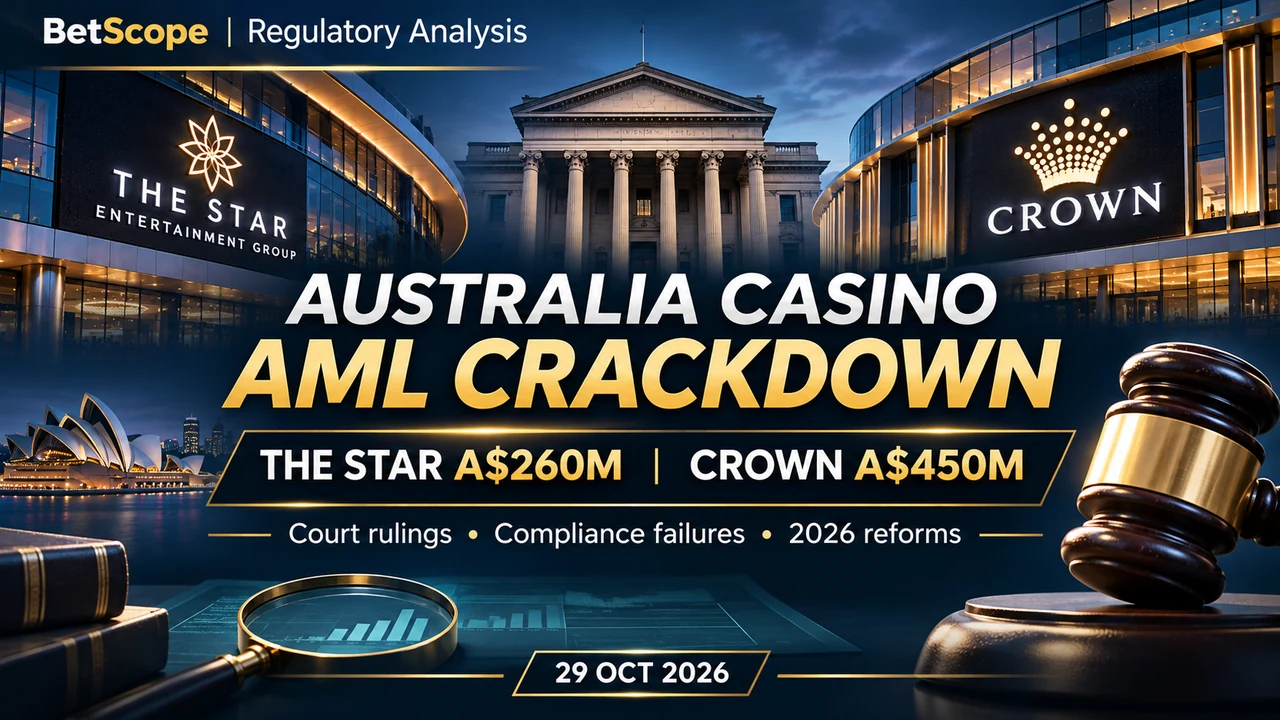
Australia’s regulation of casinos extends beyond gaming licences. Under the Anti-Money Laundering and Counter-Terrorism Financing Act 2006 (AML/CTF Act), relevant gambling businesses must assess and manage financial-crime risk. Two widely reported Federal Court proceedings offer useful case studies: The Star’s A$260 million civil penalty announced on 28 October 2026, and Crown Melbourne and Crown Perth’s A$450 million combined penalty ordered on 11 July 2023.
Both cases were pursued by the Australian Transaction Reports and Analysis Centre (AUSTRAC), but they involved distinct defendants, evidence, litigation and judicial considerations. Their significance is not simply that the fines were large: they illustrate how transaction monitoring, enhanced customer due diligence, junket exposure and oversight can break down.
What does AUSTRAC regulate, and who controls casino licences?
AUSTRAC is Australia’s financial intelligence unit and AML/CTF regulator. Its responsibilities include supervising reporting entities and taking civil enforcement action under federal law. Casino licensing and the right to run gaming operations are also determined under separate state-based regimes. A Commonwealth AML/CTF penalty is not automatically a licence cancellation order.
Civil regulatory breaches likewise should not be reported as criminal money-laundering convictions of the operator or every customer under review. Risk indicators, failures of controls and proven underlying offences are legally different propositions.
The Star: high-risk players, funding channels and junket oversight
In its 28 October 2026 statement, AUSTRAC said the Court found The Star failed to maintain a compliant AML/CTF program and adequately monitor customers for money-laundering and terrorism-financing risk. Failures included insufficient verification of some customer information and source of funds, weaknesses in higher-risk third-party transactions and cash deposits, and problematic oversight of junkets and private gaming rooms.
AUSTRAC cited more than 1,200 customers able to use higher-risk gambling channels. That number must not be misrepresented as a count of people convicted of financial crime. The court-ordered civil penalties were A$195 million for the Sydney entity and A$65 million for the Queensland entity, totalling A$260 million.
Crown: weaknesses in risk assessment and board oversight
On 11 July 2023, the Federal Court ordered Crown Melbourne and Crown Perth to pay a combined A$450 million penalty over two years, plus AUSTRAC’s costs. The companies had made admissions as part of a process in which Crown and AUSTRAC jointly submitted a proposed penalty for the Court’s approval.
The regulator’s case materials identified inadequate assessment of financial-crime risks, insufficient risk-based controls, transaction monitoring that did not match the scale and complexity of operations, gaps in enhanced due diligence for high-risk patrons, and inappropriate board and senior-management oversight.
Crown’s larger dollar penalty does not establish an official ranking of misconduct between Crown and The Star. Penalty amounts reflect the evidence, statutory framework, conduct, procedural context, other enforcement measures and the Court’s reasons in each independent case.
Five shared compliance lessons for casinos
Know your customer. Initial identification is only the beginning. Operators must maintain risk-appropriate information and understand relevant parties associated with accounts or transactions.
Verify funding risks. An unusually large cash transaction, opaque third-party payment or unexplained source of wealth may require further examination and enhanced customer due diligence, depending on the circumstances.
Monitor continuously. Transaction-monitoring controls should identify unusual patterns and respond when a customer’s risk changes. An alert without investigation or appropriate escalation is not a complete control.
Govern junkets and VIP operations. Valuable relationships do not displace the operator’s legal obligations to identify and manage financial-crime risk.
Hold management accountable. Written policies, staff training, internal challenge, board oversight and evidence of remediation all matter. The existence of a compliance manual does not prove the control works.
Australia’s 2026 reform: what does the A$5,000 threshold mean?
Australia’s updated AML/CTF laws took effect for existing reporting entities from 31 March 2026, with transition arrangements for some obligations. One specific change lowered the customer due diligence exemption threshold for certain gambling services from amounts below A$10,000 to amounts below A$5,000.
This is not a universal rule that every casino transaction above A$5,000 must be reported as suspicious. The A$10,000 physical-currency threshold transaction reporting requirement is a separate obligation, while suspicious-matter reports depend on their own legal triggers. Customer and transaction risk can also require enhanced measures below a numeric threshold.
AUSTRAC states that new ongoing CDD obligations apply from 31 March 2026; transitional arrangements may apply to particular initial CDD changes. Affected businesses need to assess their applicable service categories and transitional position rather than assuming the same rule applies to every bet or payment.
FAQ: casino AML penalties and regulatory obligations
Were Crown and The Star fined in the same proceeding? No. The cases were litigated separately, although both concern the federal AML/CTF framework.
Did the penalties prove all casino revenue was criminal proceeds? No. Penalty findings about compliance failures do not automatically establish that every related transaction was a crime.
Can AUSTRAC itself restore a suspended casino licence? Federal AML enforcement and state casino licensing are different regulatory processes.
Is A$5,000 the new casino suspicious-reporting threshold? No. The reform concerns a CDD exemption for certain gambling services, not a blanket suspicious-transaction reporting threshold.
BetVerity analysis: a lasting regulatory topic
The enduring story is whether casino businesses can demonstrate effective monitoring and intervention when lucrative customers or commercial intermediaries generate elevated risk. The Star and Crown should be examined as distinct cases with shared regulatory lessons, not merged into a single scandal or a league table of wrongdoing.
Related BetVerity coverage: the separate October 2026 report on The Star’s A$260 million court penalty, and the analysis of its casino-licence and financial position. This article is the longer-term Australian casino compliance reference.