
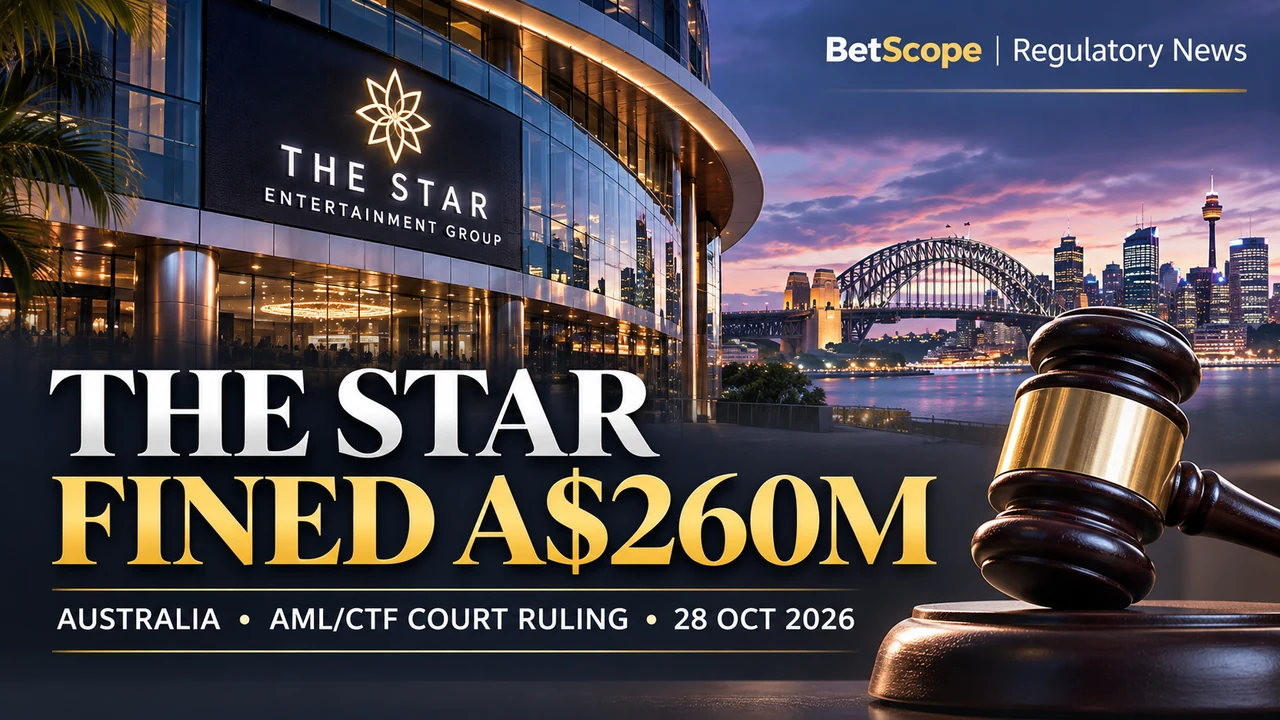
Federal Court orders A$260 million in penalties against The Star
Australia’s Federal Court ordered two casino operating entities of The Star Entertainment Group to pay a combined A$260 million in civil penalties on 28 October 2026, following proceedings brought by the Australian Transaction Reports and Analysis Centre (AUSTRAC) in November 2022.
The judgment, *Chief Executive Officer of AUSTRAC v The Star Pty Limited* [2026] FCA 1606, allocated A$195 million to The Star Sydney and A$65 million to The Star Entertainment QLD, associated with the group’s Queensland casino operations. The penalties are to be paid in four instalments over approximately 19 months. These are Commonwealth civil penalties, distinct from earlier state regulatory sanctions.
What did The Star do wrong under Australian anti-money laundering law?
The Federal Court found failures to maintain a compliant anti-money laundering and counter-terrorism financing (AML/CTF) programme and to monitor customers sufficiently to identify, mitigate and manage relevant financial-crime risks. The historical conduct examined in the proceedings ran from November 2016 to November 2022.
The shortcomings included inadequate checks on high-risk customers, insufficient verification of information and sources of funds, and poor visibility over certain gambling payment channels. AUSTRAC described channels involving third-party transactions and cash deposits where the identity of the person providing the money was not properly recorded. Such weaknesses made it harder for authorities to trace suspicious funds.
VIP customers, junkets and elevated-risk payment channels
According to AUSTRAC, more than 1,200 customers were able to gamble through channels that carried elevated money laundering or terrorism financing risks. The case also examined the management of junket and VIP business relationships, along with the operator’s response to known risk indicators.
The Court noted that junket revenue during the relevant period exceeded A$1.4 billion and that The Star itself estimated approximately A$1.33 billion in revenue from high-risk customers. These were revenue figures, not judicial findings that equivalent amounts represented laundered funds; the categories should not be added together as if they were mutually exclusive.
Why did the judge select A$260 million rather than A$400 million?
AUSTRAC sought around A$400 million, while The Star argued that a penalty above A$100 million could endanger its ability to continue operating. Justice Cameron Moore weighed the scale and seriousness of the breaches against measures already imposed and the need for a proportionate deterrent.
The judgment took account of approximately A$200 million in earlier state penalties for substantially overlapping conduct, the impact of casino licence restrictions and external supervision, and remediation steps introduced since the conduct occurred. The Court permitted staged payment rather than requiring the full sum immediately.
That payment schedule does not amount to the restoration of any casino licence or a determination that the company’s financial challenges have ended. Those matters are governed by separate regulatory and commercial developments.
A significant AML/CTF precedent for Australia’s casino industry
The ruling underlines that written policies alone are insufficient: casinos must operate effective customer due diligence, source-of-funds checks, transaction monitoring and governance oversight in practice. Commercial returns from VIP gaming or junket relationships do not remove the legal obligation to manage financial-crime risks.
The judgment imposes civil, not criminal, penalties. It does not establish that every customer referenced in the proceedings committed a crime, and business revenue figures must not be relabelled as proven criminal proceeds.
BetVerity will continue tracking official updates about payment of the penalty and separate casino licensing decisions.